NOT YOUR USUAL SUSPECTS

A group blog featuring an international array of killer mystery, suspense, and romantic suspense writers. With premises and story lines different from your run-of-the-mill whodunits, we tend to write outside the box. We blog several times a week on all topics relating to romantic suspense and mystery, our writing, and our readers. We welcome all comments and often have guest bloggers. All our authors can be contacted separately, too, using their own social media links.

We find our genre delightfully, dangerously, and deliciously exciting - join us here, if you do too!

NOTE: the blog is currently dormant but please enjoy the posts we're keeping online.


Julie Moffet . Cathy Perkins . Jean Harrington . Daryl Anderson . Nico Rosso . Maureen A Miller . Sandy Parks . Lisa Q Mathews . Sharon Calvin . Lynne Connolly . Janis Patterson . Vanessa Keir . Tonya Kappes . Julie Rowe . Joni M Fisher . Leslie Langtry

Wednesday, February 1, 2017

Writer on the Stress Express

When my older sister tripped off to college, I had the happy fortune of inheriting her old-school record player. It came in a cute little suitcase, along with a massive collection of vinyl 45s. I scratched the heck out of them all, as I was fond of dropping the needle willy-nilly on my favorite parts of each song. But by far the most worn was The Kingston Trio’s 1959 version of The M.T.A. Song (popularly known as “Charlie and the M.T.A.”). You can listen to it here: (Note: There's a brief, spoken intro.)

Often called "The MTA Song", it was written in 1949 by Jacqueline Steiner and Bess Lomax Hawes. Also known as "Charlie on the MTA", it tells of a man trapped on Boston's subway system (MTA). The song was originally recorded as a campaign song for Walter O'Brien. This version of the song, with the candidate's name changed, became a 1959 hit.:

Basically, poor Charlie was a working-stiff who paid his dime fare to ride the Boston subway—but then discovered he was stuck on the train forever because he didn’t have the extra nickel to pay his transfer fee after a sudden, nefarious fare hike. So—this was the best part, in my view—good ol’ Charlie’s wife went down to the station every day at lunchtime to pass a sandwich to him through the window of the train as it roared past. Yikes.

Admittedly, it’s a catchy tune, and of course as a kid I was clueless about its darker political history. But why exactly have I always been fascinated by Charlie’s cautionary tale? It's true I’m a Beantown-born girl, often short on allowance money, and a major train aficionado (my grandpa worked for the Erie Lackawanna.) I suspect there's something more to it, though.

The idea of being stuck in limbo, watching the world and time pass by, over and over, with no prospect of relief other than a measly daily sandwich, is somewhat unsettling. And it’s one thing if your train is empty, with a creepy guy staring at you from the other end of the car, and quite another if it’s packed with people and you are the sandwich, hanging on for dear life to a pole or strap or the coat of the large man standing next to you.
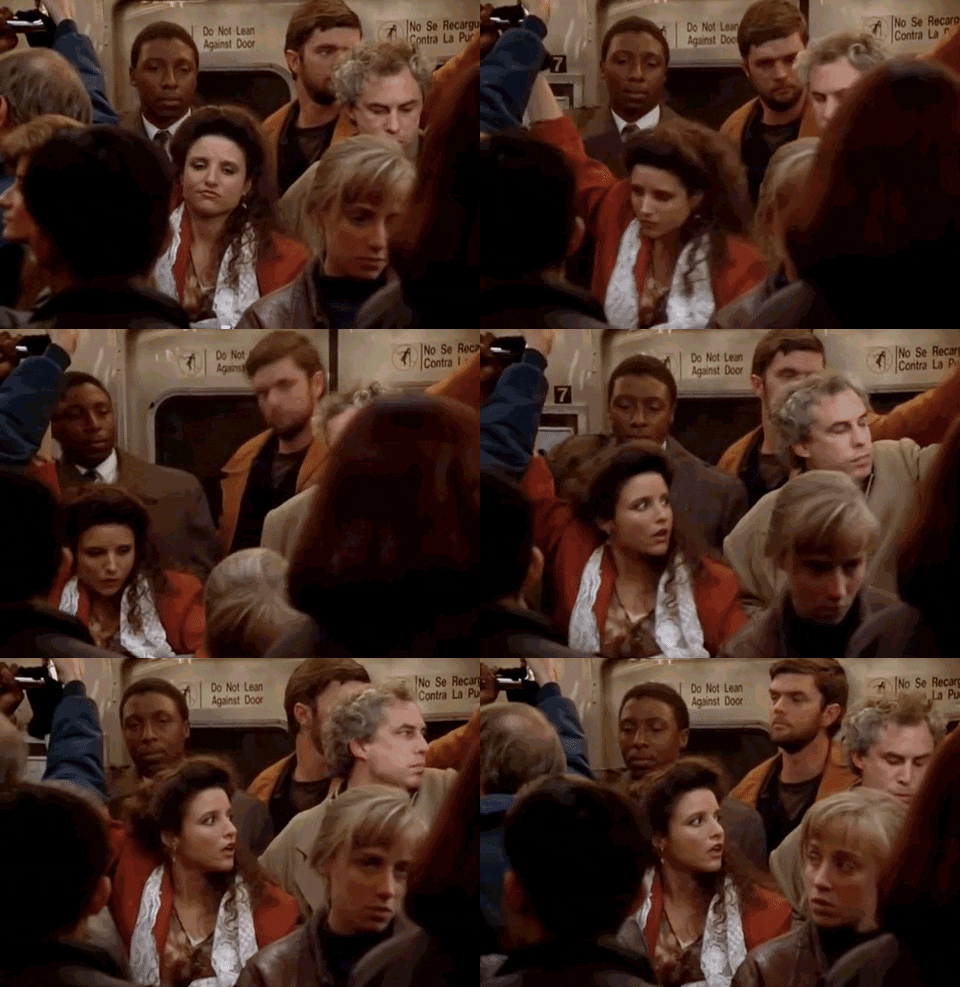


But logistics aside, did Charlie hate his new life as a commuter to nowhere? Or did he welcome it as a respite from his troubles? And if he were a writer like me, would he have used the time to observe his fellow passengers and buckle down to write the Great American Mystery Novel—or brood over lost freedoms, unpaid bills, and missed deadlines? Was he endlessly stressed about all the possible ways he might get off that train, or did he ultimately come to accept his fate? Or…did he secretly enjoy his passive existence as a perpetual passenger? Did he really NEVER get off of that train?

One thing is for sure: Poor Charlie became not only one of the most famous guys in Boston, but also the mascot of the current MBTA (Massachusetts Bay Transit Authority). You can walk up to any ticket vending machine and purchase a reloadable Charlie Card or Charlie Ticket. (Are you sure you want to risk it?)


My kid self and I remain concerned. Where is Charlie now, exactly? Did he end up dying on that train and buried under the tracks somewhere? Does his ghost haunt the “T,” as locals still call the Boston transit system? Or did one of those windbag politicians mentioned in the song finally intervene successfully for Charlie, and release him to the loving arms of his faithful, sandwich-bearing wife?

Which brings us to another issue. Why didn’t Mrs. Charlie just bring him a nickel instead? Maybe she didn’t want him back. Maybe no one wanted him back. Maybe the whole thing was a plot to…

Yeah, I know, sigh. And I agree with you. This whole obsession with Charlie and the M.T.A. has to end, so I can finally finish my latest (and by “late,” I mean really late) manuscript and return to my regularly scheduled life and long-suffering friends and family. I wonder if Amtrak still offers that cool writer-in-residence train scholarship…

All aboard! And beware the closing doors.


Monday, January 30, 2017

Why I Read.

I tried. I wrote a whole post on reader events and swag but the longer I looked at it the more I realized I couldn’t post it.

In light of what’s happened in our country the last few days, it felt disingenuous to talk about something on the fun/frivolous side.

Don’t get me wrong. I know the world continues to revolve and businesses must continue to run. Writers must continue writing, promoting and selling their books. But there is a time where we must stand up for ourselves and our beliefs. To lock out the real world and what’s happening in it doesn’t do any service to anyone. Will I lose readers because I want equality for all Americans? I guess the answer is yes. (Which truly astounds me, but...) The opening line of the constitution is "We the people of the United States..." Not "we the men" or "we the white guys in powdered wigs" or "we the christians." I don't understand the need of some people to dictate how others live their lives. Live and let live. It's not so hard to do. I don't understand what happened to compassion. 

Personally, my social media has been cut by more than half. I find it hard to post about books when so much upheaval is happening in the country. Don’t get me wrong, in this instance, I think upheaval is needed and is a good thing. Americans should voice their opinion peacefully when so much is at stake.

For instance... if Americans really embodied what the Statue of Liberty stands for then they should be furious with the current state of affairs. Here is a small – and widely known – section on the monument’s plaque written by Emma Lazarus:

 "Give me your tired, your poor,

Your huddled masses yearning to breathe free,

The wretched refuse of your teeming shore.

Send these, the homeless, tempest-tost to me,
I lift my lamp beside the golden door!"


Powerful words, are they not? 

To ban people because of their religion goes against everything our country stands for. There is NO religion synonymous with terrorism. None. Terrorists come in all shapes and sizes from all religions and all walks of life. To hold a whole race or religion accountable for the actions of a few is despicable.  America has plenty of its own homegrown terrorists like Timothy McVeigh, Terry Nichols, Eric Robert Rudolph, and most recently Dylann Roof among many others. But there was never a thought to ban the white guy.

America is made up of people from everywhere who have different beliefs. Why is that bad?

Let's look at some cliches: Strength in numbers. Divide and conquer.
They are cliches for a reason. We are being divided and prime for being conquered. 

To sit by and watch/let the country move in its current direction without speaking out is to condone it. I can’t do that. To me, this is not a Democratic or Republican issue. It is an American issue. It's about common human decency. I'll repeat that. 

Common human decency.

We are all part of the human race. We all bleed the same color. 

So I protest. I call, write and email senators and legislators. I do research and choose where I spend my money.

And I read. I’m so sick to my stomach by what’s happening that I NEED books to escape. I need to forget for just a few minutes everyday that the world has turned upside down. I need to believe that we’ll come through this and everything will be okay. Romance helps me believe that happily ever after is possible.

That’s why I read.


These views are solely my own as I cannot speak for any other participants of this blog.

Saturday, January 28, 2017

Retreating

What is it about a writing retreat that makes us so productive?
Is it the creative energy in the house? 
Knowing other people are writing away (and you should be too)? 
Or is it because you left behind ____ (fill in your own blank) and you better make use of the time?

So what is a writing retreat? Basically, you go…away and write. 
A retreat can be an organized event someone else arranges, an off-season rental house with friends, or an inexpensive hotel room where you hole up and stash energy bars in your computer case.
A writing retreat isn’t everyone’s idea of fun. When my friends ask what I did while I was away for the weekend, I shrug and say, “I wrote.”
They’re mystified. They can’t fathom why I leave home to do that, when I have an office and a computer in my own house. Then again they also don’t have any idea that, when I say, “I wrote,” I mean I wrote eight plus hours a day. I wrote over 12,000 words on a new story. (Of course, they also can’t understand why I’d want to spend eight hours a day writing.)
But the point is, I can’t be that focused at home.
Unlike a writing conference, which can be wonderful in a different way, the point of a writing retreat isn’t classes or meeting editors and agents. Although, the group I go away with has shared marketing ideas and…maybe I should back up a bit.

Way back in 2008, a group of women from the Pacific Northwest finalled in the Golden Heart—and formed a bond based first on writing and then on friendship. Every year since then, we’re gotten together over the long Martin Luther King weekend for a writing retreat. While there’s tons of writing, there’s also laughter and stories, Courtney Milan’s lessons on branding, Rebecca Clark’s yoga sessions and Rachel Grant’s chocolate martinis.

I’m halfway through a new story, with most of the remaining scenes blocked out. I haven’t a clue about the title or cover. Hmm… wonder what the women are doing this weekend?


Have you ever been on a writing retreat? What do you think is the best part?


Wednesday, January 25, 2017

WORDS, WORDS, WORDS!


     In the award-winning musical, My Fair Lady, Eliza Doolittle--discovered in Covent Garden, declares that she’s sick of words, words, words—the street urchin transformed into a lady wants to be shown not told.

      Words according to Mr. William Shakespeare should: “suit the action to the word, the word to the action…”

      Writers treasure the gift of language—the spoken sounds that led to photographic symbols used to keep accounts. No one agrees on the origin of language but agree the written word evolved through visual methods developed in diverse societies. Towards the end of the fourth millennium B.C. in southern Mesopotamia, a huge increase in population occurred. The city of Uruk, surrounded by secondary settlements outgrew all the other inhabited locations and there were many places of worship ruled by a priest-king. The temple estate’s need for accounting and allotting of revenues led to the transcribing of figures on clay tablets. A century later, word-signs were added. Proto-cuneiform writing on clay and wood are thought to have existed in Turkey and Syria—clay was inexpensive and resilient and a reed or stick used to sketch hieroglyphics into the dampened clay. Writing practices advanced in many different cultures in the Bronze Age. Sumerian cuneiform, Egyptian hieroglyphs, Chinese logographs, Mesoamerican(Olmec and Maya) and about 2,000 B.C. the first alphabetic writing by Semitic workers in the Sinai.

     The pith and stems of the Papyrus was used in ancient Egypt as writing material manufactured around the 4th millennium B.C.E. Inexpensive and simple to produce, papyrus was insubstantial and by the 10th century was gradually being replaced by parchment. The invention of wood-pulp paper made writing less expensive.  In 1440, Johann Gutenberg invented printing from separately cast metal types. The press transformed the way populations defined the world they lived in and spread within several decades all over Europe. The exchange of ideas and increased literacy altered society and strengthened the arising middle-class.
     The first story ever written is believed to be The Epic of Gilgamesh written on 12 clay tablets between 1500 and 1200 B.C. and discovered in King Ashurbanipal’s library in Nineveh and is still available in hardback, paperback and eBooks. There is one imprint left on clay tablets and can be read at the British Museum. 
      For us, words may be savored, generate new ideas within our books, suggest plots, belong to a character—our job is to suit the action to the word, the word to the action. Words that show the antagonist’s motivation, and the protagonist’s will to champion a righteous cause. Words that draw the reader into time, place and action and keeps them turning the page.

Monday, January 23, 2017

THE LAST WORD


THE LAST WORD 


            A friend of mine has always joked that when he dies, he wants his ashes sprinkled over a girls’ dormitory. If that’s not doable, when his end is near, he’ll row out to sea with a jug of wine, drink it, and then all happy, he’ll pull the plug out of the bottom of the boat. Next day, the papers will read: Man Lost At Sea.

 Those two examples of someone trying to face up to his own demise are one way to approach the inevitable. But some people can face the end seriously enough to write their own obituary. Have you considered doing so? I mean, who better? You know yourself the best of anyone, and after all, you are a writer. Chances are, you’ll do a more in-depth job of it than a grief-stricken (hopefully) relative who’s dealing with all the last-minute details of your funeral. The flowers, the music, the eulogy, the after-service repast.

 Wanting to practice what I’m preaching, I’ve taken a stab at composing my own obit:

 Jean Harrington was a beautiful woman, a gifted novelist with a brilliant wit. She loved a party (true) and a good tale (whether true or not) and her entire extended family, with some notable exceptions (you know who you are), adored her. Jean was proud of her accomplishments, especially her children, grandchildren and her published novels (not including the ones under her bed). Etc., etc., etc.

 As you can see, my obit is a work in progress, but I’m determined to stick with the job to the bitter end. So I ask again, how do you feel about all this? Will you write your own farewell? Or leave the job up to Digger O’Dell and simply row out to sea with a jug of happiness?


Jean Harrington is the author of the award winning, tongue-in-cheek, Murders by Design Mystery Series. The five books in the series star an interior designer, Deva Dunne, who never met a house she didn’t love or a cold-blooded killer she didn’t hate. Jean’s books are available through Amazon.    


More Popular Posts