NOT YOUR USUAL SUSPECTS

A group blog featuring an international array of killer mystery, suspense, and romantic suspense writers. With premises and story lines different from your run-of-the-mill whodunits, we tend to write outside the box. We blog several times a week on all topics relating to romantic suspense and mystery, our writing, and our readers. We welcome all comments and often have guest bloggers. All our authors can be contacted separately, too, using their own social media links.

We find our genre delightfully, dangerously, and deliciously exciting - join us here, if you do too!

NOTE: the blog is currently dormant but please enjoy the posts we're keeping online.


Julie Moffet . Cathy Perkins . Jean Harrington . Daryl Anderson . Nico Rosso . Maureen A Miller . Sandy Parks . Lisa Q Mathews . Sharon Calvin . Lynne Connolly . Janis Patterson . Vanessa Keir . Tonya Kappes . Julie Rowe . Joni M Fisher . Leslie Langtry
Showing posts with label Daryl Anderson. Show all posts

Friday, June 10, 2016

Cemetery Stories


People often ask me where I get my ideas for stories. Of course, all fiction stems from the imagination and the simplest answer is that I make it up. But the imagination is not an bottomless pool of ideas--like anything else, it needs to be fed. So when not actually scribbling away, I'm busy replenishing the toolbox of imagination.

One sure way to get my creative juices flowing is a visit to an old graveyard. From Wolfe's Look Homeward, Angel to Gray's Elegy Written in a Country Churchyard, writers have sought inspiration in these cities of the dead. Join me for a little tour of some of my favorite spots.
Is she looking homeward?
The Angel of Peace
Forest Hills Cemetery,  Boston
This contemplative angel brought to mind the sad lyricism of Thomas Wolfe,
You can't go back home to your family, back home to your childhood, back home to romantic love, back home to a young man's dreams of glory and of fame, back home to exile....back home to the old forms and systems of things which once seemed everlasting but which are changing all the time--back home to the escapes of Time and Memory--Thomas Wolfe
A penny for your thoughts?
Antietam Cemetery, Maryland
The Battle of Antietam on September 17, 1862, was  the bloodiest day in American combat history with over 23,000 casualties on both sides. More than twice as  many Americans were killed or mortally wounded in combat at Antietam that day as in the War of 1812, the Mexican War, and the Spanish-American War combined.

Previous visitors had left coins on many of the soldiers's headstone. Most were pennies, though I spotted a few nickles. Was this a fee for the ferryman or was there some other meaning?

Later I read that coins left at grave sites held a special meaning for the military dead, with each denomination meaning something different. But it all comes down to remembrance, which is the last gift the living give the dead.
Antietam Battlefield
City of the Dead, with luxurious above-ground accommodations,
courtesy of Marie Laveau
Lafayette Cemetery, New Orleans
Mark Twain was much impressed with the neat necropolises of New Orleans:

Many of the cemeteries are beautiful, and are kept in perfect order. When one goes from the levee or the business streets to a cemetery, he observes... that if those people down there would live as neatly while they are alive as they do after they are dead, they would find many advantages in it; and besides, their quarter would be the wonder and admiration of the business world.

I was touched by these dual headstones in Copp's Hill, the grave site of two young brothers, one-year-old Josiah and his three-year-old Nathaniel, who died on the same bleak November day in 1721.In not too long a time, the writing on the stones will be erased.
Copp's Hill Burying Ground
Boston
I have heard it said that parents in olden days didn't mourn their lost children as we do because childhood death was so common. What nonsense! Here is the Puritan poet Anne Bradstreet lamenting the death of her infant  grandson, who died being but a month, and one day old.
No sooner came, but gone, and fall’n asleep,
Acquaintance short, yet parting caused us weep;
Three flowers, two scarcely blown, the last I’ th’ bud,
Cropt by th’ Almighty’s hand; yet is He good.
With dreadful awe before Him let’s be mute,
Such was His will, but why, let’s not dispute,
With humble hearts and mouths put in the dust,
Let’s say He’s merciful as well as just.
He will return and make up all our losses,
And smile again after our bitter crosses
Go pretty babe, go rest with sisters twain;
Among the blest in endless joys remain.
 
Memorials aren't limited to angels and headstones. When Grace died at five years old from whooping cough, her lifelike statue was encased in glass, where it remains as pure and unblemished as the day it was created. From her expression, she must have been a serious little soul.
Forest Hills Cemetery
Boston

Some statuary borders on the whimsical--check out this pair of beds.
This might just be a straightforward representation of the actual beds of the deceased, but every time I look at this picture I think of Prospero's words, when he realized the party was indeed over.

Our revels now are ended. These our actors,
As I foretold you, were all spirits, and
Are melted into air, into thin air:
And like the baseless fabric of this vision,
The cloud-capp'd tow'rs, the gorgeous palaces,
The solemn temples, the great globe itself,
Yea, all which it inherit, shall dissolve,
And, like this insubstantial pageant faded,
Leave not a rack behind. We are such stuff
As dreams are made on; and our little life
Is rounded with a sleep.


I bet Shakespeare visited a graveyard or two in his day!

Sweet dreams.


Tuesday, April 12, 2016

If it's April, this must be Boston!

It's April and in our house that means it's time for the Boston Marathon!


This will be the sixth time my husband has run Boston, and I've been along every step of the way--well, almost every step, if you leave out the actual running of the marathon. If you've been lucky enough to experience the Boston Marathon, you've been lucky indeed.

Boston, the City on a Hill

At my first visit, I'd been excited about experiencing Boston, a city I'd wanted to see since childhood. I wasn't disappointed. The narrow cobbled streets conjured the past. Had John Adams and cousin Sam tramped along this very passage? 


Trudging over the North End, I thought of Lovecraft, whose short story Pickman’s Model took place here. Lovecraft had described the area as a confusing warren of twisting streets and  subterranean passageways.

At Copp's Hill Burying Ground, I found the Tomb of the Mathers and thought of those stiff-necked 
Puritans, who searched for God and found demons and witches instead.

Boston is a touchstone for American history and literature, and each year I return, I discover new points of contact.

A Little History

Like so many great things, the Boston Marathon came from humble beginnings. Inspired by the revival of the marathon at the Paris Olympics, the 1897 race had a handful of runners.

Boston Marathon, 1910
No surprise, the early races were an exclusive gig for white guys. Women didn't make an appearance until 1966 when the bandit runner Roberta "Bobbi" Gibb crashed the stag party. Not allowed to officially enter the race, Bobbi had hidden in the bushes, just past the officials. After the starting gun, she shot out and  joined the race, finishing with an unofficial time of 3:21:40

Next year Kathrine Switzer kicked it up a notch. Sly Kathrine registered as K. V. Switzer. All went well until halfway through the race when the officials became aware of Kathrine's presence. One enterprising official attempted to run Switzer down and forcibly remove her from the race. No problem, K. V. reached the finish line with a time of 4:20:00. This didn't impress the Boston Athletic Association director who groused:

"Women can't run in the Marathon because the rules forbid it. Unless we have rules, society will be in chaos. I don't make the rules, but I try to carry them out....If that girl were my daughter, I would spank her."

Women were formally invited to the party in 1972 and nowadays days the Marathon is an inclusive


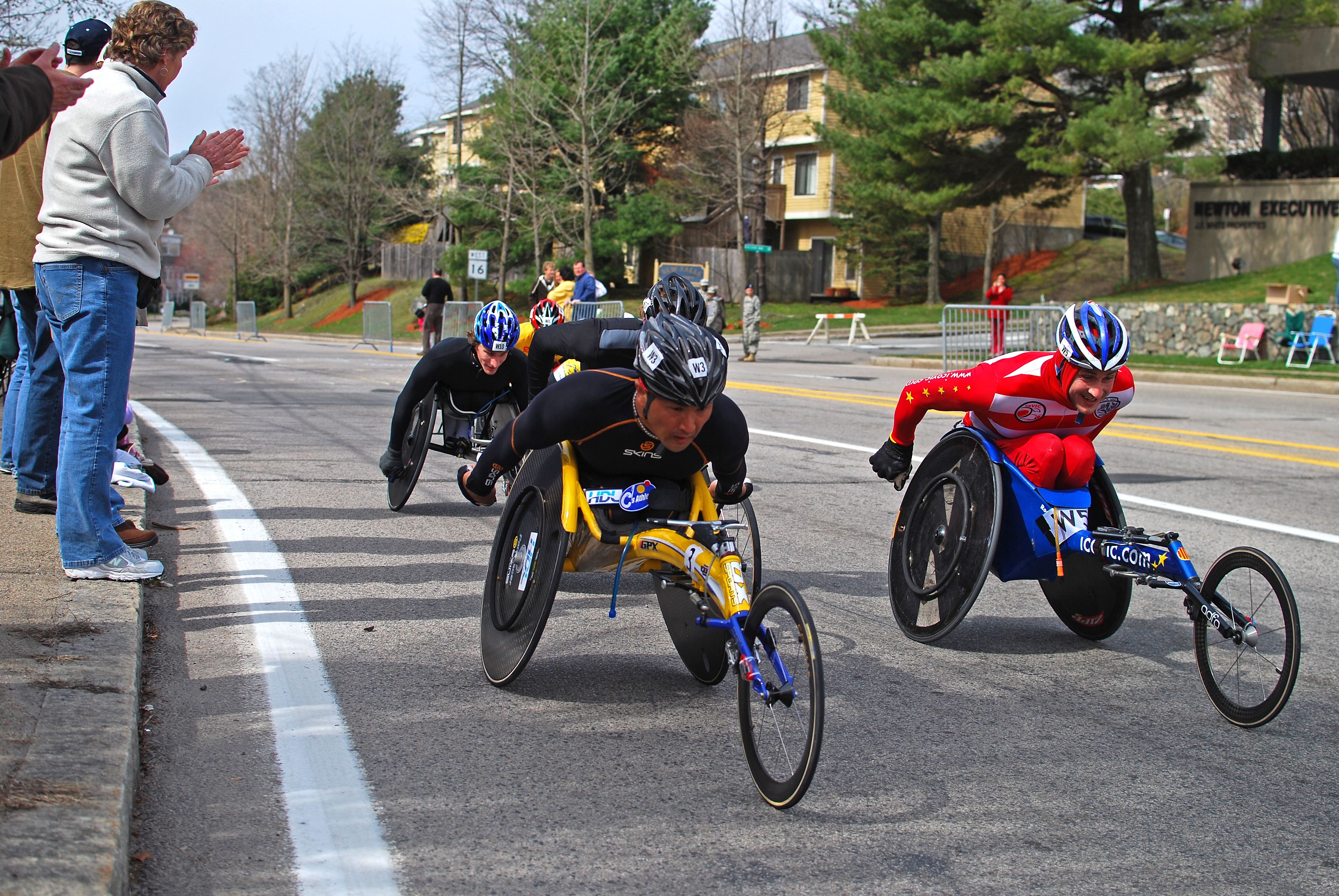
event that welcomes people of all stripes, including some incredibly fast speedsters on wheels.

Which is as it should be--things always seem to work better when everyone's invited to the part.

The modern Marathon is a triumph of planning, logistics, and optimism.


In the predawn, 30,000 runners are transported to the start in Hopkinton where they wait in holding pens (sort of like cattle) until their appointed start. The route winds its way through several New England towns--from Scream Tunnel at Wellesley College to the heartbreaking hills of Newton.
Standing on Boylston Street, I learned that there's nothing like the constant roar of the crowd as the endless stream of runners poured into the finishing straight. There is something indescribably beautiful in the act of people coming together for a common purpose--runners ran, people cheered, and the world seemed like a pretty good place.

For every year save one, I was on Boylston, cheering home the runners, but in 2013 I had a publishing deadline. So rather than watch the race, I spent the day cooped up in my room, tapping away on my laptop. At around three-thirty, I  called it a day, expecting that my husband would be back soon.

We were staying in a small hotel that was within walking distance of the finish. The place billed itself as a hotel, but it had the feel of a boarding house, with four floors of creaky stairways and lots of dark corners. Lovecraft would have liked it, I think--I certainly did.

I went to the lobby for some coffee and was pouring a fresh cup when a couple rushed in through the front door. They were older and the woman had one hand clutched to her throat. The desk clerk and I stared at them--something was wrong.

"There's been an explosion," the woman gasped, hurrying inside. "People...people are running."

"A bomb?" I asked.

Both she and her husband answered at once--something about an explosion at the finish.

"The finish? But my husband's there," I said idiotically. "Are people hurt?"

No one answered. I turned away and climbed the stairs, two at a time. My mind was in a kind of freeway as thoughts fought for primacy. I knew that  my husband had brought his cell with his belongings. At least I'd be able to call.

Back in my room, I dialed my husband's cell--no answer. I told myself that he was probably still in the recovery tent and hadn't have picked up his stuff yet. Or maybe he'd had a bad race and was still on the course, though in the back of mind, I knew there might be another reason why he hadn't answered, but I pushed that thought aside.

I was dialing when there was a knock on the door. It was my husband, safe and sound. He'd been lumbering up the stairs when I'd called. He had been walking back to the hotel when the bombs exploded. The pieces of my world came back together--others weren't so lucky.

Later it occurred to me that if I hadn't been writing, I'd have been standing near the finish, as I'd done in years past. For some time, I've believed that writing saved my life, but not literally. Still, there's no point in dwelling on what might have been.

Life turns on a dime. We think the ground is stable, and most of the time it is. But there are plenty of slippery bananas peels around--one unlucky step and we fall. And sometimes we fall hard.


When we returned to Boston the following year. I was fearful that fear might have changed this glorious race. Although there was an increased police presence, the joyous mood remained. For me, the icing on the cake was when the great American runner Meb Keflizighi won the men's title.
Meb Keflizighi, 2014

Tonight I'll raise a glass of Sam Adams beer and toast the Boston Marathon--an American classic that brings out the best of us, the very best.


Friday, August 7, 2015

Mixing Genres--A Dangerous Game


Although I'd dreamed of writing when I was a kid growing up in Baltimore, life kept getting in the way of dreams, when it should have been the other way around. And so it was only after several careers, which included food service, English teacher and psych nurse, that I finally took the plunge and dove headfirst into fiction writing--though at first it felt more like a belly flop.

Coming from an academic background, I read lots of books on the craft of writing, most of which were unhelpful. (FYI, a decidedly helpful book is Stephen King's On Writing.) Wading through the material, one warning kept appearing, usually in all caps and with an exclamation point or two: 

DO NOT MIX GENRES!


"Thou shalt not mix genres!"

...the old professor guy.

I understood the danger. Readers like to know what they're getting into and if a book crossed too many genres--maybe a science-fiction western with a comic slant--it would fall by the wayside. And yet following this rule too strictly is self-limiting. I agree with David Byrne: 

Putting everything into little genres is counterproductive. You're not going to get too many surprises if you only focus on the stuff that fits inside the box that you know.
In other words, good writers make their own boxes. Either a book works, or it doesn't.

Last April in London, I had the opportunity to meet John Connolly at a book signing on a Friday night in London. Connolly is the author of the Charlie Parker thrillers. For those of you not familiar with the series, they're rather odd books with elements of crime fiction, myth, supernatural, with a dash of dark humor for spice.


Incredibly, these disparate elements come together to form a compelling universe of good and evil, and something in-between.
John Connolly and me at Waterstones, Piccadilly

So how does Connolly do it?

It doesn't hurt that his writer's toolbox is full. He's a gifted stylist whose prose often veers into the poetic. And he's no slouch at characterization. His characters not only bleed, but eat, fall in love, and make bad jokes. They live outside the pages.

For me, one of Connoly's  most touching characterizations was that of mechanic Willie Brew, whose story figures prominently in  The Reapers. Save for his association with Charlie Parker and his lethal friends Louis and Angel, Willie's  sixty years on earth have passed largely unnoticed. A workaday everyman, he worked at fixing cars, got married, got divorced, then worked some more. But in Connolly's hands Willie's small life becomes very large, achieving a certain dignity. When Willie's asked to put everything at risk for his friends, we know exactly what he's giving up.

I still think about Willie Brew. If he had the chance to do it all over again, would he make the same decision?

But perhaps the most compelling part of these novels is in Connolly's portrayal of evil.  Too often evil is rendered in the abstract, Have you ever noticed that evil is often sensed, rather than seen or felt? I think writers sometimes shy away from the concrete in their descriptions because they fear winding up with a cartoon devil with horns and tail that wouldn't scare a five-year-old.

What's not to like?
A London pub, a beer in one hand, and a great read in the other!
But Connolly doesn't look away from the face of evil. In his books, it is felt, seen, smelled, touched and even...well, you get the idea.

Here's hoping Charlie Parker keeps fighting the darkness for a long, long time.

So, I'd love to hear your take on genre-crossing. Have you crossed the boundaries as a writer? Or do you have any favorite reads that blur genre?


Wednesday, June 17, 2015

Literary London: A Visit to the Charles Dickens House


Throughout his all-too-brief life, Charles Dickens was constantly on the move. By any measure, his list of residences is astounding. Perhaps he inherited this restless spirit from his father, who moved from pillar to post, usually one step ahead of the creditors. Sadly, most of Dickens's homes no longer exist, their presence--or rather absence--marked by a sign or commemorative plaque saying Charles Dickens once lived here 


But that’s okay--a great city such as London is like the Phoenix, constantly recreating itself in the ashes of its own destruction. And anyway Dickens's London still exists in the pages of his  books. Still,there is a remaining jewel: In 1837, Charles Dickens, his wife Catherine, and her seventeen-year-old sister Mary Hogarth moved to 48 Doughty Street. Dickens was delighted with his new house, that befitted his position as a young novelist on the rise:


"It was a pleasant twelve-room dwelling of pink brick, with three stories and an attic, a white arched entrance door...and a small private garden in the rear."
Is Mr. Dickens at home?
This beautifully restored house is now home to the Charles Dickens Museum and a must-see for any lover of Dickens.When my husband and I visited, we were lucky enough to catch the costumed tour. Here's the set-up: It is 1839. Mr. Dickens and his family aren't at home, but the chatty housemaid invites us inside for a look around. I rather suspected the young flibbertigibbet was in her cups, but who can blame her? It was a chill April morning and I'd have gladly joined her in a bowl of Smoking Bishop, if she'd offered.
Welcome!


Mr. Dickens's Study

During his three-year sojourn at Doughty Street, Dickens first experienced commercial and critical success, with The Pickwick Papers, Oliver Twist, and Nicholas Nickleby. When our hostess led us into the study where he had penned these three early novels, I was momentarily struck dumb. This was where Oliver Twist drew his first breath and Nancy her last, Sensing my interest, our hostess took me aside for a private word.

"I daresay when I first entered Mr. Dickens's employ. I thought the master was mad as hops! I'd be passing on the stairs and hear him in his study talkin' and yellin' to himself in all different kind of voices. I would have sworn to the Beadle he weren't alone, though I knew the truth of it, I did." The good woman laughed and lowered her voice. "Why, once I peeked in and he were  winkin' and twitchin' at himself in the mirror, like one of them crazed folk at Bedlam!"

"He was happy here," I said and a shadow passed over the kind woman's face. "Wasn't he?"
The room where young Mary died

"You've read his books, so you know how it was--how it is. Life is always mixed up, not all one or the other. Come, let me take you to her room."

"Mary's room?" I whispered and our hostess nodded.

One night in 1837, Dickens's beloved sister-in-law Mary Hogarth fell ill.She died the next day, in Mr. Dickens's arms. Distraught, Dickens removed a ring that he had given Mary and slipped it on his own finger, where it remained for the rest of his days. Inconsolable after the loss of "so perfect a creature," he was unable--for the first and last time in his professional life--to put pen to paper. While all of London watched in trepidation, time and deadlines passed, with no new installments of The Pickwick Papers or Oliver Twist.

Of course, Dickens picked up his pen again, but he never really recovered from the tragedy--Mary's untimely death haunted his life and his fiction.  In The Old Curiosity Shop Little Nell, whose ultimate fate obsessed two continents, was the most direct representation of young Mary. Dickens was loath to let Little Nell die, but his good friend John Forster convinced him that Nell must die, arguing that an angel such as she deserved better than a conventionally happy ending.  In writing Nell's death, Dickens lamented that he felt as if he'd lost Mary all over again.

In David Copperfield, Dickens's most autobiographical novel, Mary shares a somewhat happier fate when she is resurrected in the character of Agnes. And there were so many others: as Dickens's ideal woman, Mary Hogarth was a wellspring of inspiration. It might seem hard, but that's what writers do--they mine their own lives and the lives of of the people around them to create art.

After leaving Mary's room, we followed our hostess to the dining room, where I was cheered to
find the dining table set for guests. But then, Dickens always loved company--he was an actor on the stage of life, playing his role to the hilt.

As our time at Doughty Street drew to a close, I thought that this little house was not unlike one of Mr. Dickens's books. His novels brimmed with life,but death was a constant presence, the uninvited guest at life's banquet. Though he recognized the evil that men do, he affirmed--again and again--the power of the human heart. Though a frail organ, Dickens believed that there was no darkness so profound that it could not be illuminated by a loving human heart.

I'd like to believe he was right. Wouldn't you?

Then it was time to leave 1837 and the cozy house on Doughty Street. In farewell, our hostess quoted these words form the conclusion of The Pickwick Papers, when our narrator bids a final goodbye to that goodhearted fool, Mr.Pickwick.

Let us leave our old friend in one of those moments of unmixed happiness, of which, if we seek them, there are ever some, to cheer our transitory existence here. There are dark shadows on the earth, but its lights are stronger in the contrast. Some men, like bats or owls, have better eyes for the darkness than for the light. We, who have no such optical powers, are better pleased to take our last parting look at the visionary companions of many solitary hours, when the brief sunshine of the world is blazing full upon them.

Well said, Mr. Dickens.


Check out Daryl's website.

More Popular Posts