NOT YOUR USUAL SUSPECTS

A group blog featuring an international array of killer mystery, suspense, and romantic suspense writers. With premises and story lines different from your run-of-the-mill whodunits, we tend to write outside the box. We blog several times a week on all topics relating to romantic suspense and mystery, our writing, and our readers. We welcome all comments and often have guest bloggers. All our authors can be contacted separately, too, using their own social media links.

We find our genre delightfully, dangerously, and deliciously exciting - join us here, if you do too!

NOTE: the blog is currently dormant but please enjoy the posts we're keeping online.


Julie Moffet . Cathy Perkins . Jean Harrington . Daryl Anderson . Nico Rosso . Maureen A Miller . Sandy Parks . Lisa Q Mathews . Sharon Calvin . Lynne Connolly . Janis Patterson . Vanessa Keir . Tonya Kappes . Julie Rowe . Joni M Fisher . Leslie Langtry
Showing posts with label self-publishing. Show all posts

Wednesday, September 21, 2016

HYBRID AUTHORS – WHY THE INCREASING TREND?

You’ve all heard of a ‘hybrid author’, right? Authors who publish via both the traditional and indie routes? After months of debating whether it would be the right decision for me, I have jumped on the bandwagon of the ever increasing number of hybrid authors.

Let me tell you why…

My debut series, Vengeful Love, was published by Harlequin’s Carina Press earlier this year. I loved the experience. From getting the deal and starting up a relationship with my editor, to seeing the finished product. But, as a debut author, I didn’t have my next deal lined up before the series was released. I found myself in a dilemma—readers were calling for my next book and, though I had a complete manuscript, the traditional process meant it would likely be 12 to 18 months before my next novel would be released (although some digital only imprints will publish on shorter timescales).

Therein lies the main motivation behind me becoming a hybrid author. TIMING. If I put out an indie title, I can choose my own timeline. I can give readers what they are asking for, and keep momentum between traditional deals. Timing is a huge positive associated with indie (or self-published) releases. But it was not the only thing I had to think about.

My greatest reservation was that I would not be handed a readymade TEAM of editors, designers and marketeers. I would have to find my own team and how would I know if they were any good? Actually, it was not as difficult as I thought. I asked my indie author friends for recommendations. Most editors will provide a free sample of work and designers have a catalogue of covers you can use to help you make the right decision. It is actually great to be able to FREELY MAKE DECISIONS about your book.

Perhaps my biggest concern, is that responsibility for marketing now rests solely with me. Whereas traditional publishing houses have a loyal following of readers willing to take a chance on their books, indie authors must work very hard to build their own BRAND. (That said, even with traditional publishing, authors these days are required to market themselves heavily through social media and other channels.)

PRICING and ROYALTIES. I am grouping these two together because I consider them related. In terms of pricing FLEXIBILITY, the traditional route leaves an author with little or no influence over the retail price of a book. The reverse is true of self-publishing. Indie authors can set their own prices and utilise mechanisms such a price PROMOTIONS and Kindle Unlimited (i.e. free to subscribers of Amazon’s Kindle Unlimited library in return for royalties). Royalty percentages are also significantly higher for self-published authors. However, indie books are commonly priced lower than traditional books. This, together with more regular price promotions, tends to mean the average retail price of a book is less for indie authors.

Related to pricing and important to remember, is that an author choosing to self-publish will have initial EXPENDITURE for covers, editors etc. whereas a traditional publishing house would generally assume these costs.

Another consideration is access to PLATFORMS. While most platforms (e.g. Barnes and Noble, Amazon) and formats (ebook, print, audio) are available to indie authors just as they are to traditional publishers, there is significantly more work for one author to spread him/herself across multiple platforms, whereas traditional publishing houses are already set up to do this. Also, while physical stores may sometimes pick up self-published authors, they are much more likely to acquire traditionally published paperback books.

Finally, let us consider READERSHIP. While traditional publishing has loyal followers, these days there is a huge indie-supportive readership out there, a community traditional authors may not find themselves part of.

Let us put all this together in a visual and see which route scores best.

Category

Traditional Publishing
Indie
Publishing
Time from writing to publishing

X
Building a team
X

Choice of covers, artwork and marketing strategy


X
Ease of establishing a brand following
X

Ability to set prices and flexibility to utilise price promotions


X
Royalties

X
Initial expenditure
X

Ease of access to multiple platforms
X

Readership – brand loyalty / indie-supportive community
X
X

In summary, you can see both the traditional and ‘new-age’ routes have positives and negatives. Looking at this table, it may not be difficult to see why many authors are choosing to combine the benefits of both routes and become hybrid. Perhaps the greatest benefit is that there are two tranches of readers, those loyal to traditional publishers and those supportive of indie authors. Even acknowledging some crossover, being hybrid affords authors access to a much greater readership by combining both.

My first indie title and standalone novel, Scarred by You, releases on 24 October 2016. For more details, follow me here:


Friday, July 31, 2015

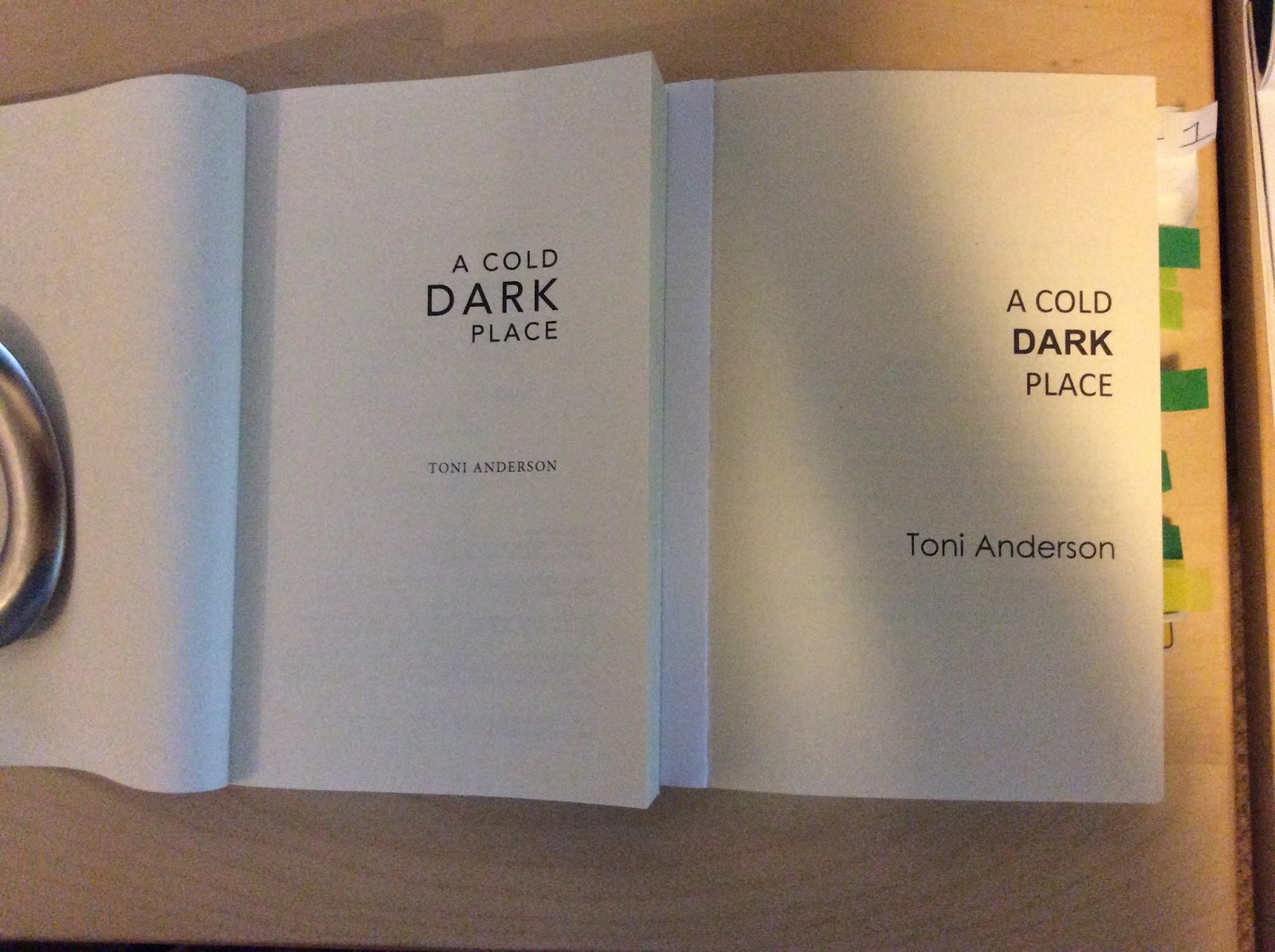
Don't Judge A Book By Its...Interior

After and Before 
The funny thing was I was quite happy with my interiors. I seemed to have avoided a lot of the associated hassles people spoke about when making print books for Createspace. I used Word and formatted the print versions myself, and I was meticulous, and I followed the guidelines exactly.

Then I accidentally received the judges comments back from a contest I entered and BAM! Apparently, I suck. I won't go into detail because that wouldn't be professional. I decided that while I might not be able to win that reader over, I was in a position to rethink my interior formatting.

So I did.

I'd been on a panel with Julianne MacLean last year and knew she used Createspace to format her interiors. So I approached my contact there and she (love her) actually offered me a freebie to see how I liked their service--it's hard to get a better offer than that, right?
After (Createspace) and Before (me)
Top-createspace       Bottom-Me

OK--while at first I wasn't seeing a big difference, I do like the way they did the Copyright page and my list of other books. Then I looked inside at the story itself...

After (Createspace) Before (me)


The difference seems to be in the margins and in the kerning. It's subtle and yet their version seems a lot more professional than mine. So, I'm sold. I did a good job (IMO), but their's looks like a 'proper' book. I haven't redone all my books yet, just the Cold Justice Series. Now my cover artist is adjusting the cover size so I can load these new versions onto my local bookstore's Cafe Press printing machine. Then I'm going to check out Ingram Spark.

So although it's a bit of a kick in the teeth to hear negative things, you have to try and use them to empower you in some way. It's easy to be bitter and life is too short :) There are other places that format interiors too. Ask around and find someone you like.

Now I have a box of books formatted the old way, LOL. Guess what? I'll probably use them for contests.

The End!
Visit Toni Anderson at her Website or on Facebook or Twitter.


Sunday, February 1, 2015

I-SPY - a little thing called VAT...

Join the authors and friends of Not Your Usual Suspects for an occasional series of posts about their world of reading, writing and publishing.

Short and sweet, hopefully both informative and entertaining - join us at I-Spy to find out the how's and why's of what we do.


TODAY'S POST: I-Spy something beginning with ...VAT!

Value Added Tax (VAT)
is a European Union (Europe and the UK) tax on sales. It's the tax that you probably thought didn't apply to you if you were producing e-books, and also: American / publishing with a US publisher / self-publishing from America or at least a non-EU country / in the EU but not yet making £81k from your self-publishing (I wish *g*) ... or any combination of these that used to apply.

BUT NOW IT AFFECTS YOU.

As with all tax, it's a looooong, boring, stuffy old subject. But I'm here to bring you the BRIEF highlights so you know how it affects you as a Reader, Published Author, and/or Self-Publishing Author (SPA). Wherever you are in the world!

What was the 2014 situation?
Up until 31 Dec 2014, VAT was charged according to the country you lived in. So if a publisher was US-based (or in another non-EU country) they never came across it. And if an SPA lived in the US (or in another non-EU country), it didn't affect them either.

However, if an SPA (like me in the UK) or your publisher were EU-based and you were selling e-books, you'd have had to pay VAT on your sales to your country's government. BUT as there's always been a minimum threshhold for paying it, most individuals and small businesses never got called on to pay anything.

NOTE: Amazon are based in Luxembourg *dum dum DAH music*. Because that's a EU country, they've been paying tax on their sales to Luxembourg. But the rate there is only 3% on ebooks, whereas it can be anything between that and 28% elsewhere in Europe. This has a large significance when you look at the change that came into place on 01 Jan 2015...

What happened on 01 Jan 2015?
Everything changed. VAT now depends on the country of the BUYER not the SELLER. So it doesn't matter where an SPA or a publisher is based - it's where the CUSTOMERS are that matters.
So...
- a US publisher selling to US customers - no tax. But selling to EU customers - tax has to be recorded and paid to the VAT authorities.
- However small an SPA may be, the same rules apply.
- the seller has to establish the customer's country when they sell, make sure they're accounting for the right VAT rate, AND keep the records of how they proved where that customer is for 10 years.

What's the problem?
Well, in theory it's all meant to charge the seller a tax rate that's relevant to where their sales are, which seems more fair (see Amazon above). Also it means the tax funds will be shifted into the country that's making the sales, not just all of it going - for example! - to Luxembourg.

But the way the legislation has been brought in, it catches a lot of smaller businesses who have been taking advantage of the ease of online, digital business, and it's causing them fresh horror .


For example:
- there's no minimum threshhold. If you sell ONE digital book to ONE customer in the EU, you have to register for and pay VAT.
- the EU countries all have different rates of VAT, so you have to be able to add on a different rate each time you make a sale. Only the large corporations have the resources and systems to do this.
- all customers now have to be identified to one country or another, and records have to be kept of the supporting information for 10 years. This isn't as easy as you'd think, especially in the world of online, immediate sales.
- official returns have to be made to your "base" EU country on a quarterly basis, by country of sale.

Ouch!
Yes indeed. What are the issues that may affect YOU?

A reader in the EU will see an increase in the price of ebooks, because most publishers and bookstores based in the US/outside the EU will now add on the VAT at checkout.

Small, EU-based publishers are withdrawing from direct sales because of the admin burden that's NOT compensated by possible increases in price.

SPAs will have to think carefully about selling to EU customers. If you sell directly - and outside of Amazon etc - you'll have to account for VAT. That means an increased admin burden, and a variable profit on your book's price, depending on the VAT rate in each customer's home country.

Authors may see a different royalty amount earned on sales to EU countries. If the seller adds on the VAT, you'll still get your royalties based on the net price. But some sellers will take the VAT off an inclusive price *before* calculating royalty. So you may get less.

Any good news?
Well, if you sell through Amazon, All Romance, and the established e-publishers - they'll sort the tax out for you. You can rest easy, little will change apart from your readers maybe having to pay more for your books.

If you personally continue to sell direct and worldwide, you'll have to account for VAT for EU customers. But no one's expected to have to account to all the EU countries individually - the VAT authorities allow you to choose one "base" country and make a single, combined return of your sales and the VAT due every quarter.

There are several focus groups campaigning right now for amendments to the legislation, including a minimum limit before sellers have to account for VAT, like there is for trade in physical goods. That would allow most SPAs and small publishers to get back in the game.

*

Like I said, it's a hot topic at the moment and has barely had time to bed down in people's minds. There are plenty of places to find out more if you want or need, including but not restricted to, http://euvataction.org/, https://www.gov.uk/government/publications/vat-supplying-digital-services-to-private-consumers, and your local tax advisor. It's not just ebooks that are affected, but all sales of digital products that are delivered at the "click of a button".

Will keep you posted....:)


Clare London, Author
www.clarelondon.com
Writing...Man to Man

Clare also runs an accountancy service for UK authors at Quids & Quills. Pop on over there if she can help with any of your VAT, other taxation and accounting issues :).


********************************


PAST and FUTURE POSTS cover:
Kindlegraph / the art of research / writing male/male romance / rejection and writer's block / building suspense / writing love scenes / anti-piracy strategies / audio books / interviews with editors and agents / using Calibre.
We welcome everyone's constructive comments and suggestions!

Wednesday, January 7, 2015

Twelve Step Program, Anyone?

by Janis Patterson

Help.

I really need help.

As most of you know, I spent half of last year republishing my backlist (and two new novels) through my own company Sefkhat-Awbi Books. It was a lot of work (and a lot of money!) but once they were out there I wouldn’t have to worry about them again. Or so I thought.

Of course, there is always the continuing publicity, which is the bane of all writers both self and traditionally pubbed, but there was one pitfall I didn’t foresee, one which is strictly on me.

Curiosity.

One of the benefits of self-publishing is that you can see your sales numbers almost instantaneously. One of the dangers of self-publishing is that you can see your sales numbers almost instantaneously.

Oh, I started out with plans to be good and businesslike. I checked my sales stats in all markets first thing in the morning, right after turning on the computer. I checked my sales stats in all markets last thing at night, right before turning off the computer. Fine. But a day is a very long time when you’re excited about a new career as a publisher and you work at the computer all day long. It’s a new world to me, as I sold my first novel in 1979, back when everything was done by snail mail and royalties came sometimes a year or more later. And you never saw your sales figures, which publishers guarded as closely as the secret of  the meaning of life.

Unfortunately, it seems little has changed since then for too many publishers, other than email replacing the snail. In self-publishing, however, you get figures instantly and money either monthly or quarterly. I never knew that information could be so addictive.

My descent started slow – first morning and evening, then a quick look at lunch. Then mid-morning, and mid-afternoon, and… well, you know. I started keeping my cell phone in the bathroom so that when I got up to use the toilet at night I could give my numbers a quick check without disturbing The Husband. While at lunch with friends or at a meeting I became adept at working the phone without looking until I could get a quick look at the numbers screen. Seeing the sales rise or – as happens depressingly often – stay the same is much more engrossing than a well-scripted drama.

So – I’m wondering if there is a twelve step program for self-publishers like me who have become addicted to checking their sales numbers. Or even if there should be. Where does good business research end and obsession begin?

I have no idea. Anyway, I have to get this blog posted and then before turning off the computer I think I’ll check my numbers one last time…


Help.

More Popular Posts