NOT YOUR USUAL SUSPECTS

A group blog featuring an international array of killer mystery, suspense, and romantic suspense writers. With premises and story lines different from your run-of-the-mill whodunits, we tend to write outside the box. We blog several times a week on all topics relating to romantic suspense and mystery, our writing, and our readers. We welcome all comments and often have guest bloggers. All our authors can be contacted separately, too, using their own social media links.

We find our genre delightfully, dangerously, and deliciously exciting - join us here, if you do too!

NOTE: the blog is currently dormant but please enjoy the posts we're keeping online.


Julie Moffet . Cathy Perkins . Jean Harrington . Daryl Anderson . Nico Rosso . Maureen A Miller . Sandy Parks . Lisa Q Mathews . Sharon Calvin . Lynne Connolly . Janis Patterson . Vanessa Keir . Tonya Kappes . Julie Rowe . Joni M Fisher . Leslie Langtry
Showing posts with label creative writing. Show all posts

Wednesday, February 28, 2018

On Procrastination & Writing


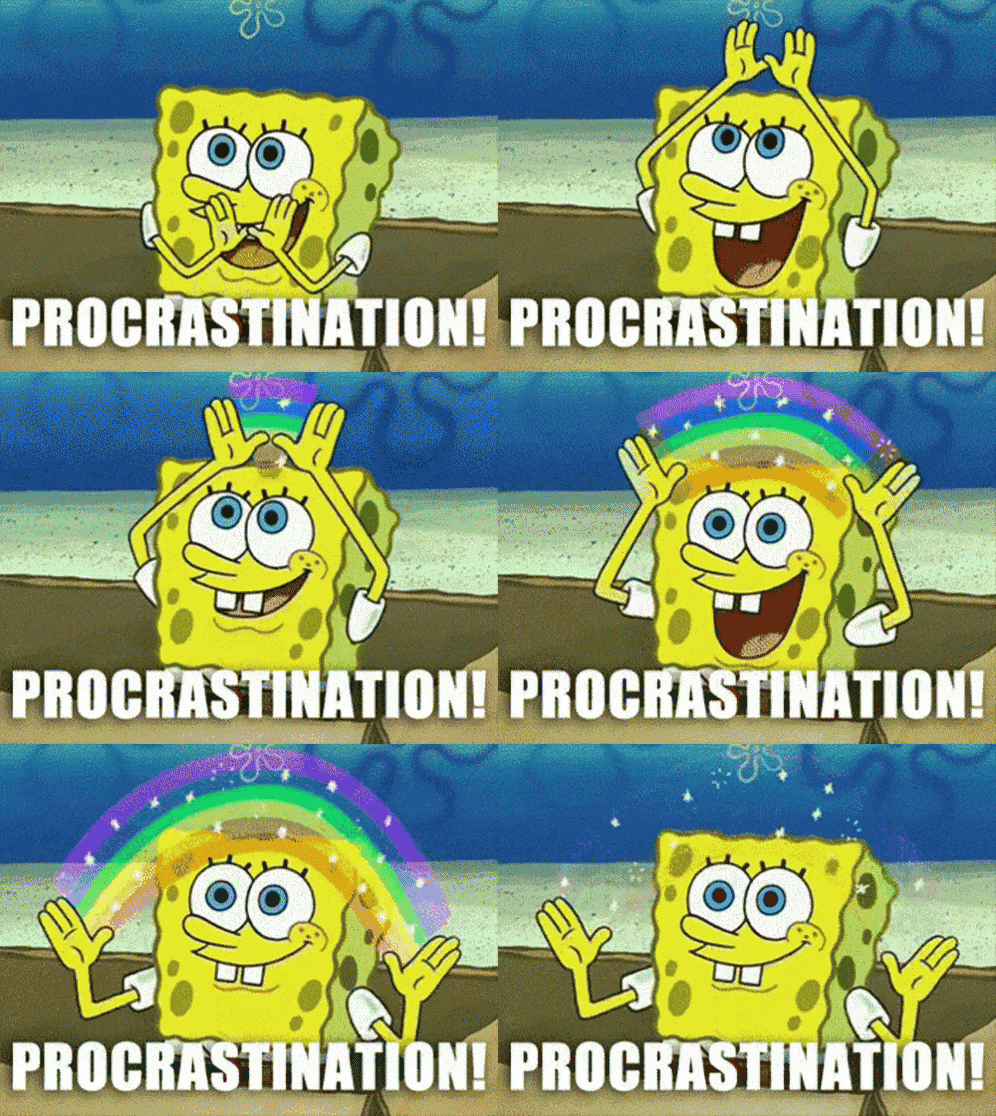
I am a master of procrastination. I am also a writer.

I know – I shouldn’t be admitting this. Not in public. But we’re all friends here, right?

Deadlines are great. I love deadlines. They tell me when to coast and when to panic. They give me an excuse to stay up late, eat junk food and blow off social commitments I shouldn’t have said yes to in the first place. Because of, you know, that deadline.

Procrastination can be rationalized if you try hard enough. It’s a mental break while your mind is working out what you’re doing next in the background, a.k.a. your subconscious. That Netflix binge is research. Writing a blog post or short story for submission is a workout using a different set of creative muscles.

Then again, maybe you’re just putting off until tomorrow what you were supposed to have gotten done yesterday.

But it’s not all bad. As an expert-level procrastinator, I’ve got a few tricks to get past it and I’m willing to share them with you. Because we’ve all got to face those deadlines sometime, right?


1. Disconnect from the Internet
Turn over your phone and the wifi on your laptop. While not foolproof (phone alerts are still an ongoing distraction), this will dissuade you from falling into a Netflix/Facebook/YouTube/Twitter/Instagram/Snapchat etc. vortex of just one click and then I’ll get back to work.

Because it’s never just one click, is it?


2. Leave the house to work
Cafés are great. Bars if you prefer less caffeination and more inebriation to get your writing done. Go where people won’t bug you and there’s enough going on for you to feel like maybe you’re procrastinating when you’re staring off into space for 5 minutes but it’s not 5 hours of binge watching later. And fresh air! Always a good thing.


3. Start Slow
Try paying a bill when it arrives instead of waiting until the day it’s due. Book that dental cleaning appointment instead of delaying until your jaw has swelled to the size of a grapefruit and you need root canal surgery. Get that grant proposal ready a month before the deadline so other people can give you feedback rather than leaving it to 11:59 PM on the day it's due and hoping your internet connection doesn’t drop at that critical moment.

The more you practice, the easier it (should) get. Right?


It’s ok. You’ve got this.


What are your tips and tricks to deal with procrastination? Share them in the comments below.

==

Beth Dranoff writes the Urban Fantasy/Paranormal Suspense Mark of the Moon series, published by CarinaPress / Harlequin and sold through most online booksellers. Currently she’s working on Shifting Loyalties (a.k.a. Mark of the Moon – Book 3). She lives in the Greater Toronto Area with her family, her dog, and more books than she can count. Is it before noon? Then there’s probably a mug of coffee nearby too. Like her on Facebook, follow her on Twitter or drop by her site at bethdranoff.com.


Wednesday, December 6, 2017

The Dreaded Outline

I hate detailed outlines.

There, I said it.

Yes, I understand the need to know exactly what’s going to happen in my book. Yes, I get that I should have these plot twists and aha! moments in firm mental view before I start writing. Yes, I get that it takes some of the oh crap what is this author going to deliver this time stress off my incredibly talented and long-suffering editor.

And yet.

Here’s a dirty secret I don’t tell everyone: I am, by writing nature, a pantser.


I love the thrill of the write. The feeling that I’m reading a book, not knowing exactly what’s going to happen next, except it’s me coming up with the words. The rush of those words spilling out from my unconscious onto the notepad or computer screen.


Ok. I will admit that there are (many) times when that approach involves adrenaline and white knuckles and why do I do this to myself moments. Swearing up and down that next time – NEXT TIME – I will do a proper outline and save myself from this stress.


Probably explains why, for Shifting Loyalties (book 3 in my Mark of the Moon series), I agreed to do it. The dreaded outline. In detail.

And I’ve tried to follow it. I have.

So…yes, I will admit that it has helped. In many places. Rather than staring at the wall or into space trying to figure out the what next of it all, I have an idea of the next what. Those days when I’m feeling uninspired, it’s ok because I KNOW WHAT COMES NEXT.


Concept right?


I’ve relied on it so much this time, though, that when I hit a point where I didn’t have the story outlined in detail – more of a broad brush with smudges at the edges   I went blank. And then I remembered why I did the outline. Because suddenly all I had to work with was a pristine page and a series of bullet points that said, essentially, something big happens and wrap up the story.

!!!

Moving forward? Pretty sure I’ll do this kind of outline again. Will I follow it though?


I’ll let you know when I get there. J

----

Beth Dranoff is the author of the Mark of the Moon series, published by Carina Press and Harlequin and available through most online retailers. She lives in the Greater Toronto Area, Canada, with her family, her dog and more books than she can count. Is it before noon? Then there’s probably a mug of coffee nearby as well.

Follow her on Twitter @randomlybibi, on Facebook or drop by BethDranoff.com to find out what's new.


Friday, June 3, 2016

Writing outside the Box - why you should!

I can see the TV advert now:
Are you tired of writing?Still committed to your genre but intrigued by something else?Loving your characters but wishing they could be on another planet / in another time / in love with werewolves?Can’t face a 50,000 words target at the moment?

I’m not suggesting anyone abandons their chosen genre. We all know the importance of creating our brand and maintaining consistent quality on our books.
But there are times you just think… not just now. The Muse is just not there. The Muse has left the building.
So don’t be afraid to try something different! Whoever said you could only write in the genre you publish? This doesn’t have to be anything to do with your publishing career – in fact, it’s probably better NOT to be. That will take the pressure off. And, God knows, you don’t have time to write another publishable novel this month LOL.

Dabble in another genre.
Revisit that WIP you’ve had for years where the elves meet the sexbots.Follow a picture prompt on the net.Write some fanfic, like you did in the old days.Use the excuse of a seasonal theme to revisit existing characters – but with a twist!Write a scene from a different gender’s POV.Write a short story in the style of the favourite author you read.Etc etc
Just for FUN! The idea is to rediscover the sparkle and buzz of writing in itself. And for those who still like there to be a purpose (looking at myself here!) there are plenty of opportunities to submit to.
I enter flashfic in QueerSciFi’s esteemed annual challenge. And although I don’t do it for the money or kudos, I won 2nd prize this year!
I enter the annual 1000words challenge on Live Journal, and have done for years. There’s no restriction at all on genre or pairing, and I’ve done horror, paranormal and comedy in the past.
I’m writing a M/F short for an RNA challenge.
always check out the picture prompt at Cryselle’s Bookshelf website and have been inspired to write flashfic for many of them.
I entered a literary festival challenge this year, a 1000 words limit. I didn’t get accepted for publication, but have a short fic I’ll enjoy sharing with my readership at some time.

Writing is so much more than publishing. Feel free to spread your wings, authors!
~~Clare London~~
www.clarelondon.com
~ And apologies for anyone who may already have read this on another blog this month - I've run up against (you guessed it) writing deadlines, and hoped you wouldn't mind me repeating it! ~

Monday, May 16, 2016

Where There's Smoke

Burn-out.

I'm not sure there is a more dreaded word in the writerly vocabulary. Some writers get panicky over Writer's Block, but block just means you took a wrong turn somewhere and you need to shift into reverse and find your way back to the road. Maybe there's a problem with the current project or maybe the current project IS the problem, but either way, Writer's Block is fixable.

Burn-out means there is no more road.

And your engine is smoking.

And the landscape around you is on fire.

A few years ago--about five years ago, in fact--I burned out. I had to cancel a slew of projects--in some cases it meant actually paying back advances. It was disastrous. I tried to be, well, not upbeat. It's hard to be upbeat about failing to meet commitments, having to repay money you've already spent, and disappointing your fans. But I tried to be pragmatic about it. Tried to look at it as a positive thing. I was pretty sure (though in my heart of hearts not absolutely positive) that I would be able to write again if I just gave myself time to refill the creative well.

So I took a sabbatical and used that time to do exactly that. I spent time with family and friends, I put a healthy schedule into place that included not eating at my desk, ending the work day at five-ish, taking vacations and even not writing every weekend. All those things helped once I got back to work, but getting back to work took a really long time. It took the full year. And while I read a lot and watched documentaries and movies and got out and about...I mostly worked during that year because a lot of my previously published work reverted to me right about then. And I was investigating translations and audio and print. All those little revenue streams kept me financially afloat during the time that I was not producing new fiction.

Since that time I've been pretty careful, pretty watchful to make sure that I did not get into trouble again. So imagine my surprise when I realized a couple of weeks ago that I was teetering once more on the edge of burn-out.

How could this be? I was working a reasonable (fairly reasonable) schedule, I was taking time out for family and friends, I took vacations and even traveled. Okay, I was falling back into the pattern of mostly working late into the evening and on weekends, I was committing to too many projects, and I was starting to panic over all the stuff there wasn't time to deal with (career planning, marketing strategies, new and additional revenue streams...)

The good news is this time I recognized the symptoms. I could have forced my through the current project but it would likely have been the final project of the year--and maybe the final project for next year as well. Instead, I faced facts and, as embarrassing as it was, told my publisher what was happening. Happily I got an extension, but even if the project had been cancelled it would be have been better than being creatively paralyzed for the foreseeable future.

Money will be tight because my financial health is built on that 90-120 day cycle we all live and die by now. But better that money is tight than having the bank cut me off entirely--and that's what we risk when we repeatedly overdraw from our creative resources.

The most important asset we have as writers is our creative energy. At all costs that energy has to be protected and nurtured. It means getting out of your head and into the real world on a regular basis. It means taking care of your physical health--get off your butt!--and it means preserving your sanity by not spending too much time on social media. There are a lot of variables in a writing career and some things can be fudged and some things can be faked, but the one thing we writers cannot do without are the words.

When we lose the words, the story stops. And when the stories stop, that is truly The End.

Now -- before you're in trouble -- is the time to take stock of your creative resources. How tired are you? How much effort do you put into replenishing that creative well? Do you have a career game plan that doesn't involve constantly producing new books to stay afloat?


More Popular Posts