NOT YOUR USUAL SUSPECTS

A group blog featuring an international array of killer mystery, suspense, and romantic suspense writers. With premises and story lines different from your run-of-the-mill whodunits, we tend to write outside the box. We blog several times a week on all topics relating to romantic suspense and mystery, our writing, and our readers. We welcome all comments and often have guest bloggers. All our authors can be contacted separately, too, using their own social media links.

We find our genre delightfully, dangerously, and deliciously exciting - join us here, if you do too!

NOTE: the blog is currently dormant but please enjoy the posts we're keeping online.


Julie Moffet . Cathy Perkins . Jean Harrington . Daryl Anderson . Nico Rosso . Maureen A Miller . Sandy Parks . Lisa Q Mathews . Sharon Calvin . Lynne Connolly . Janis Patterson . Vanessa Keir . Tonya Kappes . Julie Rowe . Joni M Fisher . Leslie Langtry
Showing posts with label writing. Show all posts

Wednesday, March 28, 2018

MY EDITOR INTERVIEWS ME!


Writers know how important it is to have a good editor. When you get an excellent editor, you consider yourself EXTREMELY lucky! 

I've worked with Carina Press editor extraordinaire, Alissa Davis, on 12 books now, and I am beyond fortunate for her incredible insight, wisdom and intuitive sense of story. A few years ago she interviewed me for my publisher. I thought it would be fun to share our interview. It's just a little peek into what goes in to the editor-author relationship!

Alissa: Julie, you were already a published author when we started working together. Did you have any expectations or concerns when we started edits on Book 1?

Julie: I really didn’t have any expectations or concerns at the start. I knew you liked the books and the characters (a lot!), based on how quickly you acquired it, so I felt comfortable with the idea that we could work out any needed edits together. You were actually like my fourth or fifth editor at that point in my career, so I’d been around the block starting fresh with an editor. Nothing scared me by then. Ha! Luckily, we were very compatible. In fact, I can honestly say you are my favorite editor ever. It is an honor to work with you!

Alissa: What aspects of editing have gotten easier the longer we’ve worked together? Harder?

Julie: A lot has gotten easier. First, I trust you implicitly. We’ve been together since the inception of Lexi and the gang. You know her and the supporting characters almost as well as I do. Sometimes better! It’s scary. J  So, when you say something isn’t working, I don’t even think twice. I trust your gut. It gets a rewrite. Also, I think that after eight books together, you don’t have to explain in as much detail what you want me to do. I get you and you get me. It’s pretty simple and totally wonderful! That’s not to say there aren’t times when you need to boink me over the head about something—there are. However, usually one comment will suffice to help me get things back on track. I call it a quiet confidence in our ability to work together to get the book pulled together exactly right. Now, I’m going to clarify and say none of this applies to the start of the book. I think I’ve had to totally rewrite the intro to each book in the series at least once. It’s just a killer for me each time. Hahaha! But after I rewrite the start based on your suggestions or comments, I always like it ten times better—so you are spot on. I appreciate the pushback and the fact that you won’t let me sneak by when you know I can do better. Ha!

Alissa: Although we’ve worked together for many books, edits do vary from book to book, right?

Julie: Absolutely true! Interestingly enough, some books require more attention to the plot and others a greater need a focus on the character arcs. Sometimes things are working and sometimes they aren’t. In my particular case that typically happens when the characters do things I didn’t expect or the story shifts in a way that is logical when I’m writing, but that I didn’t see coming in advance. Flexibility is key and taking a step back to decide what’s working and what isn’t. Occasionally things like copyright infringement (No, Julie, you can’t use Star Trek quotes even as a cultural reference) can cause a major rewrite. J


Alissa: Do you have a specific routine for attacking edits? Does it vary each time?

Julie: I have no routine when editing, probably because I squeeze in edits when I can. Luckily I work from home, and my day job is writing as well. I usually tackle one writing assignment at a time so I don’t get things mixed up in my head. When it’s time to edit a book, I turn my full focus on it. But it’s hard to predict when I’ll find time for edits, so there is no special routine I fall into. I’m definitely aware of my deadline and I try to make sure it gets done before then. Depending on the day job, that time may come in the wee hours of the night or morning. I wish I could give a glamorous answer and say I pour myself a glass of wine, listen to a relaxing soundtrack and wear a special nightie while feeling the breeze off the ocean from my open balcony, but that’s all fantasy. The reality is I’m wearing no make up and have on yoga pants and a sweatshirt, my hair is in a ponytail, I’m eating a power bar because I missed lunch, and (in the summer) my soundtrack is “Mom, he touched my stuff,” followed by “That’s because he breathed on my arm,” ending up with “Help! I think there’s a bee in my shorts. MOM!”  J

Alissa: Any advice on building a good working relationship with your editor?

Julie: Absolutely. I have a few cardinal rules:

1.)  Be Professional. That doesn’t mean your relationship can’t blossom into a friendship because when two people work really well together, that’s often what usually happens. But you both have a job to do and you are required to do it together. You must get the novel into shape so it sells oodles of copies. You need each other to do that, so build on your strengths to do it. Manners and positive interaction are always key. I always think humor helps a lot, too, especially in those critical days before a deadline.
2.)  Communicate. I know several authors who live in terror of their editor. That’s not the way it works. You are a team working together to whip a manuscript into the next blockbuster. Believe that for each and every book. If you have questions about your editor’s comments, ask. If you don’t agree, say so. Miscommunication, or no communication, is counterproductive and serves no one. Don’t be timid or scared, but don’t be overbearing or insufferable either. Go back to tip #1 and be professional. This is a business pairing and like any relationship, you need to communicate for it to work properly. The book is your product, so treat it as such.
3.)   Do Your Best Work Every Time. It’s not your editor’s job to write the book. That’s yours. Send in your finest, polished effort each time. Editing is a darn hard job. Even with what you think is a totally polished effort, there will be a lot of editing required to take it to the next level. Someone once told me that if you compare your manuscript to a car and you give your editor a two-door Fiat then you’d better understand that you are NOT coming home in a Mercedes. You’ll come home in a polished up two-door Fiat. If you want a Mercedes, then you’d better turn one in.
4.)  Learn From Your Editor. Writers should be constantly learning and working on their craft. Your editor can help enormously with that. Stay open to suggestions and challenges. I almost never start edits right away, especially developmental edits. I carefully read everything my editor says and then I think about it. Usually for a day or so. I cannot stress the importance of perspective and reflection during edits. Don’t be hasty or defensive. Make it a rule to take at least one full day to reflect.
5.)  Thank Your Editor. Their job is to make you look good. Appreciate them for that! Since their work is done behind the scenes, they do not often get the recognition they deserve. Remember that behind every successful book is a fantastic editor. If you find a good one, make sure they know it!

      Julie Moffett is the best-selling author of the Lexi Carmichael mystery series, the YA mystery/spy series, White Knights, and other books. For more information on Julie or her books, check out her website at www.juliemoffett.com.


Wednesday, March 14, 2018

When the Story Just Doesn't Work

There are few things I find more painful as a writer than discovering a story I’ve been writing doesn’t work. If I’m lucky, this happens before I’ve written too much of the book.

In truth? I’m usually not that lucky. My deleted scenes files tend to end up being an average of 100,000 words.

Sometimes it’s the characters that I can’t get a handle on.

Sometimes it’s the plot.

Many years ago, I came up with an idea for what I thought would be the first book in a new series to be set in West Africa. I really loved the hero, Rico, and the heroine, Jane. I came up with a bunch of dangerous situations Jane and Rico had to escape from. I had fascinating secondary characters who had interesting interactions with Jane and Rico. But I couldn’t get the overall story to gel. No matter how much constructive feedback I received and no matter how many times I tried to fix it, the character arcs and plot just wouldn’t meld together into a powerful story.

I think I have at least two or three completed rough drafts of that book, all with different plots. On top of those, I probably have several dozen openings and first acts. I tried so hard to do those characters justice, but in the end I had to admit defeat and put the book aside.


Years later, I had another idea for a book set in Africa. This one involved a heroine who was a primate researcher, a hero who was a reporter, and some extraordinarily intelligent gorillas.

I had a lot of fun writing an opening sequence where the gorillas helped the heroine and hero fight off some poachers. Unfortunately, after reading it over, I realized that the gorillas were acting too human, putting the story closer to science fiction than romantic suspense.

Now, I’m not afraid of bending reality. After all, I’ve created an alternate history and geopolitical structure of West Africa for my WAR series. And in the SSU series I pushed the mad-scientist-creates-superhuman-soldier envelope to the edge of science fiction.

But there was something about those gorillas that just felt as if I’d be crossing a genre line I wasn’t ready to cross. So I threw out that plot.


Now, why didn’t I just downgrade the intelligence of the gorillas? Because in my mind those human-like aspects of the gorillas were set in stone. Once certain aspects of the story become “real” to me, I can’t change them. That’s just the way my creativity works.

At least this time, I’d only written about a third of the book before I set it aside.

After a lot of brainstorming, I eventually came up with new characters: Emily is a former prima ballerina and Max is a rogue black ops agent. But yeah, it took a while to find the correct story for these two, as well. Their story is WAR: Disruption, the first book in the WAR series.

To my surprise, while I was writing the second book in the WAR series, one of my characters made a comment and I finally realized why I’d had such trouble with Rico and Jane’s story. I hadn’t understood that Rico was undercover.

I renamed Rico to Rio, because I didn’t want him rhyming with Niko, the hero of Vengeance. Rio then became a point of view character in the third book in the WAR series. Not only that, but Rio and Jane will finally get their story in book six in the series. I’ve written snippets of their new book and there’s almost nothing left of the original idea.

Funny how my subconscious was able to work all that out.


You’ve probably guessed by now that I frequently struggle to find the right characters and plot for each book. It doesn’t matter if I outline ahead of time and do extensive character development sheets, or if I just jump in and write with little to no preparation. Either way, I still end up sending a ton of writing to my deleted scenes file. I’m not happy with the time this takes, but I’m grudgingly beginning to accept that it’s just part of my process.

Still, is it any wonder that after struggling so much to get my story right my muse makes things go terribly wrong for my characters? You know what they say about payback.

****************

Vanessa Kier writes action-packed romantic thrillers with an edge. She’s set her latest series, WAR, in West Africa, where she lived for a time. She also coaches writers in Scrivener and other tech.

You can find her at: www.vanessakier.com and thewriterstechstop.com.


Monday, March 5, 2018

Laura Lippman in Gainesville!

Meeting with authors I admire is like a big-old jolt of inspiration, and I got a Venti Double Shot of it last Saturday when Laura Lippman came to Gainesville!


I was introduced to her fiction several decades ago when my sister gave me a copy of Baltimore Blues as a Christmas present.  Since then, I've looked forward to every new Laura Lippman novel and consider her one of the premier crime novelists working today. As creator of the Tess Monaghan series along with several stand-alone novels, her books are expertly plotted--with more twists and turns than the wild Ocklawaha River--but it is the authentic and superbly-drawn characters that keep  me coming back for more.

Laura Lippman
Now, I had tried for years to meet Laura at some conference or book tour, but never quite got the timing right. So I was over the friggin' moon when I learned she was coming to our library in Gainesville--a mile from my home!

From her smart novels, I already knew Laura was a smart woman, but in finally meeting her, I found her to be kind and gracious as well, with an almost working-class approach to her writing that I can relate to.

  Simply put, writing is her job and she does it well.


Although Laura was there to talk about her latest novel Sunburn, she admitted that everything past the first two chapters contained spoilers, so the discussion was wide-ranging. One thing she shared about her own writing really struck home.

When Laura first set out to write, she made a conscious decision to cast herself as a genre writer, partly because the idea of writing the great American novel was a bit beyond her. I think it was a way to take some of the pressure that goes along with the craft. 

I experienced something similar when I decided to try my hand at writing fiction. As a former English teacher, I loved Fitzgerald and Shakespeare and Faulkner, but I was no Faulkner. Heck, I wasn't even Sidney Sheldon, though I wouldn't have minded having his sales. But I might be able to write a mystery. But I'd read enough mysteries to fill a library. Maybe--just maybe--I could write one. 

Sometimes we women are often way too hard on ourselves. We demand perfection of ourselves, yet
forgive all sorts of transgressions from those we love. So calling myself a genre writer was a way of giving myself a break. 

I think that learning the craft of writing is sort of like climbing a giant ladder, the top of which is hidden in the clouds. Rather than worry about what's beyond your reach, it's best to concentrate on getting onto the next rung.

And who knows? Maybe someday, you'll reach the clouds.

Monday, December 18, 2017

Drinking While Writing: A Guide

You’ve seen us writers at your local cafe. Scribbling, typing, drinking – all in a quest for those magical words.

Even if you’re not a writer yourself, you’ve probably heard the stories. How we need specific pens, or paper, or music, or lighting, or t-shirts – OK, we admit it, we can be as superstitious (*cough* neurotic *cough*) as professional athletes when it comes to cranking out our bliss. And never – never – get between us and our working beverage of choice.


Ever wondered if there's a logic to our liquids? Or have you assumed we’re all caffeine-addled addicts clutching at our dispensers of fluid-based sustenance in order to beat back creative desperation?

I'm here to help. My gift to you, just in time for the festive season: your very own first edition copy of The Writer to Normal Person Guide to Beverages Consumed While Working

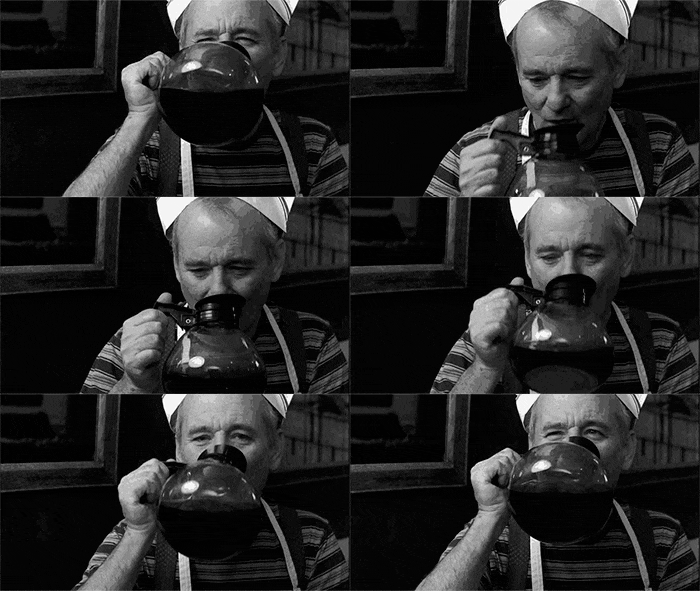
Black Coffee:
You’re not messing around. You also left the house without your usual dose of caffeine. This is the jumpstart-my-day-but-quick drink of choice. Acceptable variations include Americano, Espresso, French Press, Cold Brew and the like.


Decaf Latte:
You took the weekend off, and you’ve already had a sizeable mug of the black stuff before you hit your favourite café or in-house office space. There’s optimism in those eyes of yours; you’ve had more than enough rest and nobody needs to have too much caffeine and maybe you’ll be cutting back on the stuff in the future. Note: this phenomenological choice rarely lasts for more than a day.


Half-Caf Latte:
The drink of those who need a bit of caffeine, but aren’t ready to commit to the full jolt ramifications of their actions.


Water:
It’s hot out. And you don’t have a lot of time to write today, but need to squeeze a few words out regardless because it’s a discipline and not a whim. Alternate scenarios include water while drinking any of the other options on this list because it's important to stay hydrated.


Tea, Iced:
You’re a dabbler. Or British. Either way, this is likely a passing phase from which you’ll recover once you get serious about this writing/lack of sleep thing.


Hot Chocolate:
When you want a bit of caffeine but it’s late in the day and you don’t really want to be up all night either. Helpful for PMS, a crisis-recovery hit of endorphins, and/or self-care when what you really want to do is drink wine but can’t. Frequently found on desks at day jobs after a late night of writing, followed by fantasies of becoming a best-selling author who no longer needs a day job for money.


Wine:
Existential angst. Crisis of faith, particularly faith in oneself. A bad review, or a manuscript out on submission a bit too long. You could also be writing a sex scene, the likes of which you really hope your mother won’t be reading.


Latte (A.K.A. The Usual):
You know what you want. And what you want is to be awake, with an option for that to happen while topped with a frothy milk (or milk substitute) topping of choice. You’ve already lost sleep this week, and this is your bargain with yourself in exchange for those few more words because of deadlines or guilt.


You're welcome. 😉


Beth Dranoff is the author of the Mark of the Moon series (Mark of the Moon and Betrayed by Blood), published by Carina Press / Harlequin. Shifting Loyalties, book 3, is expected out mid-2018. Dranoff lives in the Greater Toronto Area of Canada with her family, dog, and more books than she can count? Is it before noon? Then there's probably a mug of coffee nearby too.


More Popular Posts